Verification date: October 8, 2026
This guide is for buyers who plan to use fashion-reps to discover Stussy-style fall/winter hoodies and want to verify style, size, and visible QC evidence before submitting an order. It does not replace product pages, seller information, shopping agent rules, or destination-country import regulations; actual prices, stock, available sizes, and images should be based on what you see when you order.
The Specific Purchase Problem This Article Solves
This article focuses on one practical task: you've found a Stussy-style hoodie you like, but you're not sure whether the page information is enough to support ordering, or how to compare sizing, prints, stitching, and QC photos.
After reading, you should be able to do four things:
- First judge whether the product page provides verifiable style, color, and size information.
- Use measurements like length, chest, shoulder width, and sleeve length—not just S, M, L—to choose a size closer to your target fit.
- Record visible issues from product images and QC photos, and distinguish between "not shown on page" and "confirmed to exist."
- Decide whether to proceed, ask the seller for additional photos, or hold off before submitting the order.
If the page lacks a clear product name, size chart, color options, or enough product images, this article cannot judge the actual quality for you. Missing evidence is itself a result to record. 🔍
Confirm the Style and Visible Specs of Stussy Hoodies on the fashion-reps Product Page
fashion-reps helps users discover products and go to their chosen shopping agent through the purchase link on the page. Orders, payments, warehousing, QC photos, consolidation, and international shipping are handled by the external agent site. Therefore, the reference price on the fashion-reps page is not directly equal to your final cost.
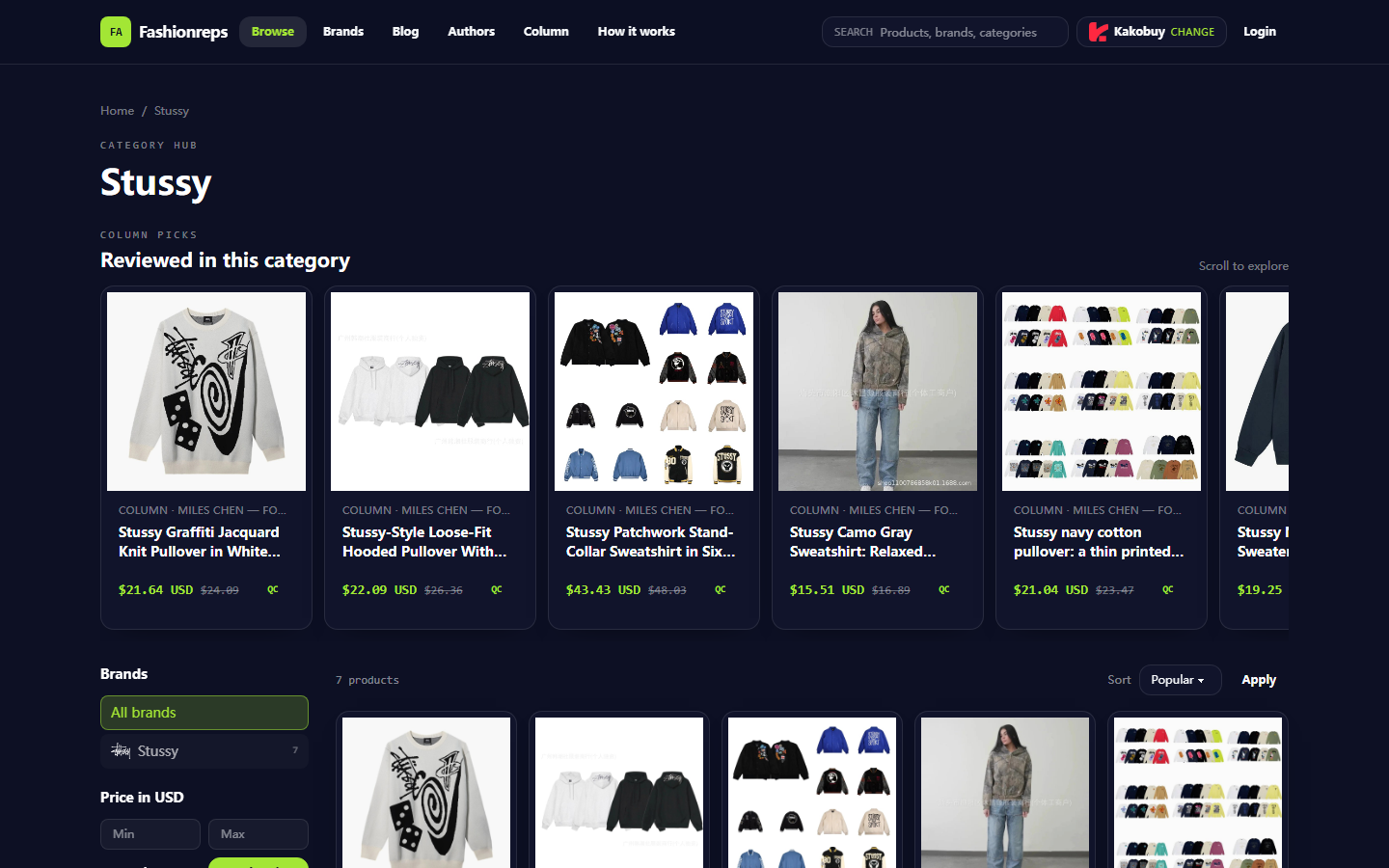
In the Stussy category page verified this time, 7 product entries are visible, including different necklines, graphics, colors, and fits. For example, the page shows a white-black jacquard crewneck pullover, a loose hoodie with embroidered lettering, a six-color panel stand-collar hoodie, a gray camo hoodie, and a 430 gsm cotton pullover hoodie. The reference prices on the category page are about $15.51–43.43, but this range only applies to the reference items shown at that time, not a uniform price, and does not include agent service fees, domestic shipping, international shipping, taxes, or other possible costs.

Image: Visible product types and reference information on the fashion-reps Stussy category page. The image is only for showing page information, not proof of actual quality or stock.
Before ordering, it's recommended to record the following item by item:
- Whether the product title clearly states hoodie, crewneck, zip-up, or stand-collar structure.
- Whether the page distinguishes between different colors, rather than showing only one representative image.
- Whether there is a complete size chart with units clearly in centimeters or inches.
- Whether the page states material, weight, or fabric composition; "cotton" and "430 gsm" are not interchangeable.
- Whether the product images clearly show the front, back, neckline, cuffs, and hem.
- Whether there are QC photos from the warehouse; product display images cannot automatically be considered QC evidence.
- Whether the purchase button leads to the agent you have currently selected.
Create a Verification Checklist from the Size Chart and Page Information like Length and Chest
The most common misjudgment with hoodies is treating letter sizes as a universal standard across products. Loose, drop-shoulder, cropped, and regular fits can have different actual lengths and chest measurements even with the same size label.
First, measure a hoodie that fits you well. Lay the garment flat and record length, chest width, shoulder width, and sleeve length; if the page uses chest circumference instead of chest width, confirm whether it's a flat measurement or a circumference measurement. The two cannot be directly compared.
You can build your own verification record in this order:
- First decide the fit you want: fitted, regular, loose, or clearly drop-shoulder.
- Choose an existing hoodie as a reference, not just your height and weight.
- Compare the actual measurements of your reference garment side by side with the product size chart.
- Mark the parts with large differences separately, such as length is right but chest is too big.
- If the page does not provide a measurement tolerance, do not treat a 1–2 cm difference as an absolute guarantee.
| Verification Item | Page Information to Confirm | Action Before Ordering |
|---|---|---|
| Length | Measurement starting point from neckline or shoulder to hem | Compare with your existing hoodie's flat measurement |
| Chest circumference or width | Flat or circumference measurement, and unit | Convert to the same unit before comparing |
| Shoulder width | Whether drop-shoulder is included | Check if it changes armhole and overall silhouette |
| Sleeve length | Starting point: shoulder seam, drop-shoulder point, or neckline | Compare with layering test with frequently worn outerwear |
| Fabric and weight | Whether composition or gsm is stated | Only record clearly stated information as known |
If the page only gives letter sizes like S to XXL without specific measurements, it's recommended to record the size status as "cannot be sufficiently verified." This doesn't necessarily mean the product can't be bought, but it means you cannot use page evidence to rule out the risk of being significantly too large or too small. 📏
Check Prints, Stitching, and Visible Flaws from Product and QC Images
Product display images are good for confirming design direction, while QC photos are closer to the specific item you're buying. But QC photos still have limitations: shooting angle, lighting, resolution, and obstruction can affect judgment. Not seeing something doesn't mean there's no problem.
When checking prints, it's recommended to observe:
- Whether pattern edges have obvious breaks, fraying, or misalignment.
- Whether the relative position of front and back graphics matches the product page design.
- Whether the print is obscured by wrinkles, making the full outline unconfirmable.
- Whether different color versions use the same graphic description; don't infer details from one version to another.
When checking embroidery and patches, it's recommended to observe:
- Whether letter outlines have obvious missed stitches or loose threads.
- Whether patch edges are flat or lifting.
- Whether the graphic is at the position described on the page.
- Whether the image is clear enough to distinguish actual stitching from compression noise.
When checking stitching and structure, it's recommended to observe:
- Whether shoulder seams, cuffs, hem, and pocket connections have obvious open seams.
- Whether hood cord holes, zippers, buttons, or stand-collar structure are completely visible.
- Whether the garment is severely twisted, making the fit impossible to judge.
- Whether there are visible issues like oil stains, holes, obvious color differences, or large-scale pilling.
When recording, it's best to use three labels:
- Confirmed: clearly visible in the image and can be located to a specific part.
- Not found: no problem seen in the clearly covered area, but does not mean the whole garment is problem-free.
- Cannot judge: angle, clarity, or obstruction insufficient to support a conclusion.
Do not rewrite "not found" as "flawless," and do not judge shadows in blurry images as stains. 🧵
What Layering and Styling Conditions to Confirm for Fall/Winter Daily Wear
The key to fall/winter wear is not just how thick the hoodie itself is, but also inner layers, outerwear, activity level, and destination temperature. If the page only says cotton or a certain gsm value, it cannot fully predict warmth.
If you plan to layer with T-shirts, shirts, or light thermal layers, prioritize checking chest, armhole, and sleeve length. Loose fits usually accommodate inner layers more easily, but overly large shoulder width may cause outerwear sleeves to bunch. If you plan to wear a jacket or down coat over the hoodie, then conversely confirm whether sleeve length and body thickness will restrict movement.
Also distinguish the following situations:
- Indoor commuting: focus on comfort and whether cuffs and neckline deform easily.
- Short outdoor periods: need to confirm outer wind resistance; don't treat a hoodie as a windbreaker.
- Long outdoor periods in cold regions: usually need extra thermal layers; don't judge sufficient warmth from the product name alone.
- Humid environments: should check care instructions and fabric information; cannot infer moisture absorption or quick-drying performance from images.
Therefore, "fall/winter style" should be understood as a wearing scenario label, not a guarantee of warmth. 🌡️
How to Record Disagreements When Community Feedback Can Only Be Clues
Community discussions can help you discover common questions, such as whether a certain fit runs large, whether a certain print is prone to position differences, or whether a size chart has inconsistencies. But without reading the full discussion context, you cannot treat a single comment as a universal conclusion.
When reading community feedback, it's recommended to record:
- When the discussion took place, and which product or version it corresponds to.
- Whether the commenter provided specific measurements, images, or measurement methods.
- Whether the same issue was raised repeatedly by multiple independent users.
- Whether there is conflicting feedback among comments.
- Whether the discussion is about the product itself, seller service, or logistics and agent experience.
If someone says "runs small," you also need to know their height, weight, usual size, and target fit; otherwise that statement can only be a lead to verify. Conflicting opinions don't need to be forcibly eliminated; you can keep them as disagreements and resolve them through the product size chart or additional measurement requests.
A more robust wording is: "Existing discussions suggest possible differences in size perception, but lack uniform measurement conditions, so cannot guarantee that a certain size fits all buyers."
Layered Conclusions on Pros, Limitations, and Missing Evidence
The advantage that can be confirmed from the fashion-reps category page is that the product discovery path is relatively clear: the page groups multiple different styles by brand, allowing users to compare necklines, graphics, colors, and reference prices before entering the external agent process. The page also clearly indicates that orders and shipping are handled by external shopping agents.
What can be reasonably confirmed at present:
- The Stussy category page has multiple hoodie or hoodie-like product entries for comparison.
- The page shows product names, some style information, and reference prices.
- There are obvious structural and graphic differences among the visible styles.
- The final purchase process must be completed through the external agent selected by the user.
What still needs to be confirmed on specific product pages or at QC stage:
- Actual stock and available colors.
- Specific measurements for each size and measurement tolerance.
- Whether the current price has changed.
- Fabric composition, weight, and care instructions.
- Whether the seller provides additional photos or after-sales handling.
- Whether QC photos correspond to the color and size you actually purchased.
- Agent service fees, warehousing fees, domestic shipping, international shipping, taxes, and destination-country customs requirements.
Therefore, this batch of page information is suitable for discovery and preliminary screening, but not enough alone to prove the workmanship, feel, durability, or brand authenticity of a specific item. In particular, cannot confirm fabric touch from product images alone, nor automatically interpret the word "Stussy" on the page as proof of official authorization or authenticity.
Final Pre-Order Review Checklist and Photo Request
Before submitting the order, you can review in this order:
- Whether the product title, color, and style match the target item.
- Whether the specific product page is still accessible, and not an empty page, redirect, or pure tag page.
- Whether the size chart has specific values, units, and measurement starting point.
- Whether your reference hoodie and target size are close in key measurements.
- Whether page images cover front, back, neckline, cuffs, and hem.
- Whether current price, stock, and agent redirect have been reconfirmed.
- Whether you understand the external agent's payment, warehousing, QC, return/exchange, and shipping conditions.
- Whether the destination country has applicable import restrictions, taxes, or declaration requirements.
If you need additional photos, make specific requests rather than just "please check quality." For example:
- Please take flat-lay photos of the front and back, ensuring the entire garment is in frame.
- Please photograph the size tag and actual measurements, and note the measurement units.
- Please take close-up photos of print or embroidery edges, avoiding glare and severe wrinkles.
- Please photograph cuffs, hem, shoulder seams, and pocket connections.
- Please confirm the color and size corresponding to the QC photos.
- If stains, damage, or obvious misalignment are found, please pause shipping and explain available options.
The final purchase judgment should be layered: if size data is complete, style information is consistent, QC photos are clear and no visible issues beyond acceptable range, you can proceed with the agent's normal ordering and inspection process; if key data is missing, supplement evidence first; if obvious structural problems, color errors, or unacceptable flaws are found, it is not recommended to continue just for a low reference price.
The conclusion is simple: whether such a hoodie is worth buying cannot be judged solely by brand name, image style, or page price. Truly useful judgment comes from specific measurements, visible details of the corresponding style, actual QC photos, and complete cost conditions. The right approach is to fill in the evidence first, then decide whether to accept the risks of size mismatch, workmanship differences, after-sales limitations, and cross-border shipping.